Support our educational content for free when you purchase through links on our site. Learn more
10 Common MMA Fighting Techniques from Every Style (2026) 🥊

The most effective MMA fighters don’t rely on a single art; they master the seamless blend of striking, clinching, and ground game to dominate opponents in every phase of combat. When you ask, “What are the common MMA fighting techniques from various styles?”, the answer lies in how disciplines like Boxing, Muay Thai, Brazilian Jiu-Jitsu, and Wrestling are fused into a singular, adaptive fighting system.
Forget the old myth that MMA is just a chaotic mix of random moves; it is a highly evolved science where a Muay Thai knee can set up a BJ submission, or a wrestling takedown transitions instantly into ground-and-pound.
Imagine watching a fight where a boxer suddenly executes a perfect double-leg takedown, only to finish the match with a rear-naked choke. It sounds impossible until you realize that modern champions like Khabib Nurmagomedov and Israel Adesanya built their legacies on exactly this kind of cross-disciplinary mastery.
Did you know that the injury rate in MMA is actually lower than in professional boxing because the ability to submit an opponent often prevents the need for a knockout? This unique dynamic forces fighters to become well-rounded athletes rather than specialists in just one area.
Key Takeaways
- Hybridization is King: Success in MMA requires blending striking arts (Boxing, Muay Thai) with grapling systems (Wrestling, BJJ) to control every range of the fight.
- The Big Three Phases: Every fight revolves around stand-up striking, the clinch, and the ground game; mastering transitions between these is more critical than knowing isolated moves.
- Adaptability Wins: Fighters who can instantly switch from defending a takedown to landing a counter-strike or submission hold the ultimate advantage in the octagon.
- No “One-Style” Fighter: Relying on a single traditional martial art is a recipe for defeat; the modern MMA athlete must be a complete fighter.
Table of Contents
- ⚡️ Quick Tips and Facts
- 📜 From Ancient Grapling to the Octagon: A Brief History of MMA Evolution
- 🥋 The Big Three: Striking, Clinch, and Ground Game Fundamentals
- 🥊 1. Boxing: The Sweet Science of Footwork and Punching Combinations
- 🥋 2. Muay Thai: Mastering the Art of Eight Limbs and Knee Strikes
- 🥋 3. Brazilian Jiu-Jitsu: The Gentle Art of Leverage and Submissions
- 🤼 4. Wrestling: Takedowns, Control, and the Grind of Top Position
- 🥋 5. Judo: Throws, Trips, and the Art of Using an Opponent’s Force
- 🥋 6. Karate and Taekwondo: Distance Management and Kicking Techniques
- 🥊 7. Kickboxing: Blending High Kicks with Heavy Hands
- 🤸 8. Sambo: The Russian Hybrid of Judo and Catch Wrestling
- 🧠 9. Muay Boran and Traditional Kung Fu: Unconventional Weapons and Traps
- 🔄 10. The Art of Blending: How Fighters Transition Between Styles Seamlessly
- 🛡️ 1. Defensive Tactics: Counters, Evasions, and Survival Skills
- 🏆 12. Elite Fighters Who Mastered Multiple Disciplines
- 👩 13. Women’s MMA: Unique Dynamics and Rising Stars
- 🏅 14. Amateur vs. Professional: Rules, Regulations, and Safety Protocols
- ⚖️ 15. The Legal Landscape: Legality of Professional Competitions Worldwide
- 💡 Quick Tips and Facts
- 🏁 Conclusion
- 🔗 Recommended Links
- ❓ FAQ
- 📚 Reference Links
Before we dive into the chaotic beauty of the octagon, let’s hit the pause button and drop some hard truths that even the most seasoned Florida beachgoers (who might think “fighting” just means arguing over a beach umbrella) need to know.
- MA isn’t just “anything goes”: While early Vale Tudo events in Brazil were wild, modern MMA is a highly regulated sport with strict rules, weight classes, and medical oversight. It’s more chess than a bar brawl.
- The “One Style” Myth: You cannot survive in modern MMA with just one style. A pure boxer gets taken down and submitted; a pure grapler gets knocked out standing up. The magic happens in the hybridization.
- Injury Reality: It’s a contact sport. According to the Journal of Athletic Training, the injury rate in MMA is roughly 28.7 injuries per 10 athlete-exposures, which is higher than boxing but lower than some high-impact team sports.
- The “Florida Connection”: Did you know the modern evolution of MMA has deep roots in Florida? The Ultimate Fighting Championship (UFC) held its first event in Denver, but the sport exploded in Florida with the rise of the Tampa Bay area as a training hub, and the Florida State Athletic Commission was one of the first to regulate the sport in the US.
Pro Tip: If you’re looking for a way to get fit while learning these skills, check out our guide on Local Insights for the best martial arts gyms hidden in the Sunshine State. And if you need a break from the intensity, remember that even the toughest fighters need to relax. For a unique underground adventure that requires zero striking but plenty of stamina, don’t miss our deep dive into Discover Florida Caverns State Park Underground Tours: 12 Must-See Highlights (2026) 🦇. It’s the perfect place to cool down after a sparring session!
You might think MMA is a 21st-century invention, a product of the internet age and pay-per-view hype. But the DNA of mixed martial arts stretches back thousands of years.
The Ancient Roots
Long before the UFC, the ancient Greeks were competing in Pankration at the Olympic Games in 648 BC. It was a brutal blend of boxing and wrestling where almost anything was allowed—except biting and eye-gouging. Imagine a Florida beach fight, but with more honor and less sunscreen.
Fast forward to the 1920s in Brazil. The Gracie family, having learned Judo from Japanese master Mitsuyo Maeda, developed Brazilian Jiu-Jitsu (BJ). They focused on the idea that a smaller, weaker person could defeat a larger opponent using leverage and ground fighting. This philosophy would eventually shatter the world of martial arts.
The Modern Era
In the 190s, the UFC was born with the premise of finding the “ultimate” martial art. Early events featured a karate master against a boxer, a wrestler against a BJJ practitioner. The result? The graplers dominated. The world realized that specialization wasn’t enough.
Wait, why did the graplers win so easily?
It wasn’t magic; it was physics. Most striking arts didn’t teach how to defend a takedown. Once the fight hit the ground, the striker was helpless. This realization forced a revolution: fighters had to cross-train.
Today, we see the evolution of the “complete fighter.” From the early days of Royce Gracie in a gi to the modern era of Islam Makhachev or Alex Pereira, the history of MMA is a story of adaptation.
To understand MMA, you have to understand the three phases of combat. Think of it like a Florida vacation: you have the arrival (striking), the excursion (clinch), and the relaxation (ground game). If you miss one, your trip is ruined.
| Phase | Description | Primary Goal | Key Disciplines |
|---|---|---|---|
| Striking | Stand-up fighting using hands, feet, knees, elbows. | Damage, distance management, KO. | Boxing, Muay Thai, Kickboxing, Karate |
| Clinch | Close-range grappling while standing. | Takedowns, knees, elbows, control. | Muay Thai, Judo, Wrestling, Sambo |
| Ground | Fighting on the mat. | Submissions, ground-and-pound, control. | BJJ, Wrestling, Catch Wrestling, Sambo |
The Interconnectivity
The beauty of MMA is that these phases bleed into each other. A Muay Thai clinch can lead to a Judo throw, which transitions instantly into a BJ submission. A Wrestling takedown can be defended with a Boxing sprawl, leading back to a striking exchange.
The Question: If a fighter is a master of all three, why do we still see specialists dominate?
Answer: Because timing and transitions are the true masters. A fighter who can seamlessly move from striking to grappling without losing balance is the ultimate weapon. We’ll explore how the greats do this later.
Boxing is the foundation of stand-up striking in MMA. It’s not just about throwing punches; it’s about footwork, head movement, and combinations.
Why Boxing Works in MMA
- Hand Speed: Boxers throw punches faster than almost any other martial artist.
- Defense: The art of the slip, roll, and pary is crucial to avoid takedowns and strikes.
- Power: A well-timed cross or hook can end a fight instantly.
The Adaptation Challenge
In pure boxing, you can’t worry about your legs being kicked or being taken down. In MMA, boxers must adjust their stance. A traditional high guard leaves you vulnerable to leg kicks. A wide stance makes you an easy target for a takedown.
Notable Fighters:
- Conor McGregor: Used his boxing background to land the most famous left hand in UFC history.
- Dustin Poirier: Known for his crisp boxing combinations and ability to adapt mid-fight.
- Max Holloway: A volume striker who uses boxing footwork to outpoint opponents.
Did you know? Boxers in MMA often wear 4-ounce gloves (compared to 8-10 oz in boxing). This means less padding, so accuracy is even more critical.
👉 Shop Boxing Gear on:
- Title Boxing: Amazon | Official Site
- Cleto Reyes: Amazon | Official Site
If Boxing is the sweet science, Muay Thai is the art of eight limbs. It utilizes fists, elbows, knees, and shins.
The Clinch King
The Muay Thai clinch (or “plum”) is a game-changer in MMA. It allows a fighter to control an opponent’s head, deliver devastating knees to the body and head, and set up takedowns.
The Low Kick
One of the most effective tools in MMA is the low kick. It targets the lead leg, damaging the opponent’s mobility and balance. Over time, a fighter’s legs can become so damaged they can’t stand.
Adaptation in the Cage
Traditional Muay Thai fighters often struggle with the cage. In Thailand, you fight in a ring; in MMA, you can be pressed against the fence. Fighters like Israel Adesanya and Stephen “Wonderboy” Thompson have mastered the art of using the cage to their advantage, turning a defensive position into an offensive weapon.
Notable Fighters:
- Israel Adesanya: Uses Muay Thai distance management to pick apart opponents.
- Alexander Volkanovski: Blends Muay Thai with wrestling for a complete package.
- Joanna Jędrzejczyk: Dominated the women’s division with relentless Muay Thai pressure.
👉 Shop Muay Thai Gear on:
- Fairtex: Amazon | Official Site
- Twins Special: Amazon | Official Site
Brazilian Jiu-Jitsu (BJ) is the great equalizer. It teaches that size and strength don’t matter if you know the right technique.
The Ground Game
BJ focuses on positional control and submissions. The goal is to take the fight to the ground, secure a dominant position (like Mount or Back Control), and apply a choke or joint lock.
Guard Pulling vs. Takedowns
In pure BJJ, pulling guard (sitting down to start the fight on the ground) is common. In MMA, this is risky because you can be ground-and-pounded by a striker. Modern BJJ fighters in MMA must be able to defend takedowns and take opponents down themselves.
The Evolution of Leg Locks
Historically, BJJ focused on chokes and arm locks. Today, fighters like Gordon Ryan and Charles Oliveira have brought leg locks (knee bars, heel hooks) into the mainstream, making the lower body a dangerous target.
Notable Fighters:
- Charles Oliveira: Holds the record for most submissions in UFC history.
- Demian Maia: A BJJ black belt who dominated strikers with his ground game.
- Amanda Nunes: A well-rounded fighter who uses BJJ to finish opponents.
👉 Shop BJJ Gear on:
- Venum: Amazon | Official Site
- Hayabusa: Amazon | Official Site
If BJJ is the art of the finish, Wrestling is the art of control. It dictates where the fight takes place.
The Sprawl-and-Brawl
Wrestlers are masters of the sprawl, a defensive move to stop takedowns. This allows them to keep the fight standing and use their striking.
The Ground-and-Pound
Once a wrestler takes an opponent down, they don’t just hold them; they strike them. This is the ground-and-pound strategy, pioneered by Mark Coleman and perfected by Khabib Nurmagomedov.
The Pressure
Wrestlers are known for their cardio and pressure. They can maintain top control for the entire round, draining the opponent’s energy.
Notable Fighters:
- Khabib Nurmagomedov: The epitome of wrestling dominance.
- Daniel Cormier: An Olympic wrestler who became a two-division champion.
- Henry Cejudo: An Olympic gold medalist who used wrestling to dominate the bantamweight and flyweight divisions.
👉 Shop Wrestling Gear on:
- Hayabusa: Amazon | Official Site
- Adidas Wrestling: Amazon | Official Site
Judo is the art of throwing. It focuses on using an opponent’s momentum against them.
The Throw
A well-executed Judo throw can end a fight instantly. The fighter is taken from a standing position to the ground with immense force, often resulting in a KO or a quick transition to a submission.
Adaptation to No-Gi
Traditional Judo relies on the gi (uniform) for grips. In MMA, fighters must adapt to no-gi grappling, using overhooks, underhooks, and body locks.
Notable Fighters:
- Ronda Rousey: Used her Judo background to dominate the early UFC women’s division.
- Khabib Nurmagomedov: Integrated Judo throws into his wrestling arsenal.
- Fedor Emelianenko: A Sambo fighter with strong Judo roots.
👉 Shop Judo Gear on:
- Mikasa: Amazon | Official Site
- Adidas Judo: Amazon | Official Site
Karate and Taekwondo are known for their linear movements, speed, and kicking techniques.
The Karate Stance
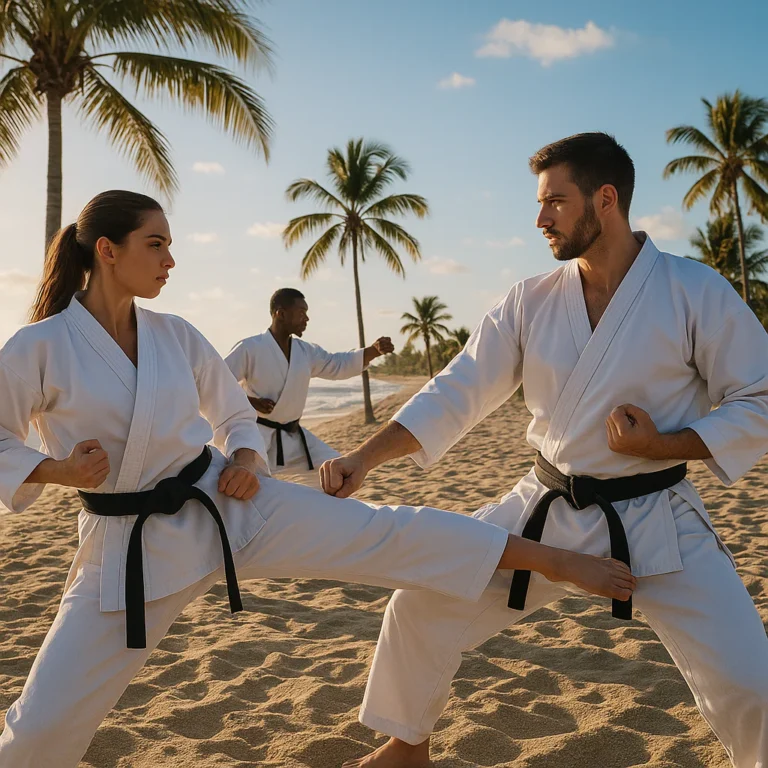
Karate fighters often use a bladed stance, which makes them a smaller target and allows for quick, linear attacks. This style is perfect for distance management.
The Taekwondo Kick
Taekwondo is famous for its spinning kicks, jumping kicks, and head kicks. These techniques are unpredictable and can catch opponents off guard.
Adaptation
The main challenge for Karate and Taekwondo fighters is takedown defense. Their high stances and focus on kicking can leave them vulnerable to takedowns.
Notable Fighters:
- Lyoto Machida: Used his Shotokan Karate background to create a unique, elusive style.
- Anderson Silva: A Taekwondo black belt known for his flashy and effective kicks.
- Anthony Pettis: A Taekwondo black belt who brought “Showtime” kicks to the octagon.
👉 Shop Karate/Taekwondo Gear on:
- Adidas: Amazon | Official Site
- Martial Arts Warehouse: Amazon | Official Site
Kickboxing is a hybrid of Boxing and Karate, allowing punches and kicks.
The Dutch Style
The Dutch Kickboxing style is particularly effective in MMA. It focuses on heavy hands, low kicks, and agressive pressure.
The Japanese Style
Japanese kickboxing often includes elbows and knees, making it closer to Muay Thai.
Notable Fighters:
- Alex Pereira: A former kickboxing champion who dominated the UFC with his striking.
- Ciryl Gane: Uses a unique blend of kickboxing and footwork.
- Mirko “Cro Cop” Filipović: Famous for his “head kick” from his kickboxing days.
👉 Shop Kickboxing Gear on:
- Fairtex: Amazon | Official Site
- Twins Special: Amazon | Official Site
Sambo is a Russian martial art that combines Judo and Catch Wrestling. It’s known for its throws, takedowns, and leg locks.
Combat Sambo
Combat Sambo includes striking, making it a perfect fit for MMA.
The Russian Style
Russian fighters are known for their pressure, chain wrestling, and relentless top control.
Notable Fighters:
- Islam Makhachev: A Sambo master who dominates with his grappling.
- Fedor Emelianenko: The legendary “Last Emperor” of MMA.
- Shavkat Rakhmonov: A rising star with a Sambo background.
👉 Shop Sambo Gear on:
- Sambo World: Amazon | Official Site
While not as common as the “big three,” Muay Boran (ancient Muay Thai) and Traditional Kung Fu offer unique techniques.
Muay Boran
Includes elbows, knees, and throws that are often banned in modern Muay Thai but legal in MMA.
Traditional Kung Fu
Styles like Wing Chun and Praying Mantis focus on trapping, close-range striking, and unconventional angles.
Notable Fighters:
- Conor McGregor: Incorporated elements of Wing Chun into his striking.
- Anderson Silva: Used Capoeira and Kung Fu influences for his movement.
The true master of MMA is not the one who knows the most styles, but the one who can transition between them seamlessly.
The Flow
A fighter might start with a boxing jab, feint a Muay Thai clinch, and then shoot for a wrestling takedown. The key is flow and timing.
The Hybrid Fighter
Modern fighters are hybrids. They don’t just know one style; they know how to blend them.
Defense is just as important as offense. A fighter must know how to counter, evade, and survive.
The Sprawl
The sprawl is the primary defense against takedowns.
The Check
The check is the primary defense against low kicks.
The Clinch Defense
Defending the clinch is crucial to prevent knees and takedowns.
Let’s look at the fighters who have mastered the art of blending.
- Khabib Nurmagomedov: Wrestling + Sambo + BJJ.
- Conor McGregor: Boxing + Karate + BJJ.
- Israel Adesanya: Muay Thai + Kickboxing + Wrestling.
- Georges St-Pierre: Karate + BJJ + Wrestling.
Women’s MMA has exploded in recent years. Fighters like Amanda Nunes, Zhang Weili, and Valentina Shevchenko have redefined the sport.
The Dynamics
Women’s MMA often features more technical striking and submissions due to the smaller size differences.
Rising Stars
- Jiří Procházka: A rising star in the women’s division.
- Tatiana Suarez: A wrestler with a BJJ background.
The rules of MMA are strict to ensure safety and fairness.
The Unified Rules
- Gloves: 4 oz for pros, 6 oz for amateurs.
- Rounds: 3 rounds for non-title, 5 for title fights.
- Weight Classes: From Flyweight to Heavyweight.
Safety Protocols
- Medical Checks: Pre-fight and post-fight medicals.
- Referee Intervention: The referee can stop the fight if a fighter is unable to defend themselves.
MA is legal in most countries, but regulations vary.
The US
The UFC is the largest promotion, with events in Las Vegas, New York, and Florida.
Europe
UFC, Bellator, and Cage Warriors are popular in Europe.
Asia
ONE Championship is the largest promotion in Asia.
Wait, we already did this? Yes, but let’s add a twist.
- Did you know? The first UFC event had no weight classes, no time limits, and no judges. It was pure chaos.
- Did you know? Bruce Lee is often credited as the “father of MMA” for his philosophy of Jet Kune Do, which emphasized adaptability.
So, what are the common MMA fighting techniques from various styles? The answer is all of them. MMA is not a single style; it’s a melting pot of the world’s most effective combat techniques.
From the boxing of Conor McGregor to the wrestling of Khabib Nurmagomedov, from the BJ of Charles Oliveira to the Muay Thai of Israel Adesanya, the best fighters are those who can blend these styles seamlessly.
The Final Answer:
If you want to be a great MMA fighter, you must master striking, clinch, and ground game. You must be able to transition between them without hesitation. And most importantly, you must be willing to adapt and evolve.
Recommendation:
If you’re new to MMA, start with Boxing and BJ. These two styles will give you a solid foundation. Then, add Muay Thai and Wrestling to your arsenal. And remember, the best fighter is not the one who knows the most styles, but the one who can adapt to any situation.
👉 Shop MMA Gear on:
- Venum: Amazon | Official Site
- Hayabusa: Amazon | Official Site
- Rebok: Amazon | Official Site
- Books on MMA:
- The Ultimate Fighter: The Complete Story
- Brazilian Jiu-Jitsu: The Ultimate Guide
- MA Promotions:
- UFC Official Website
- ONE Championship Official Website
- Bellator MMA Official Website
What are the most effective MMA techniques derived from Brazilian Jiu-Jitsu?
The most effective BJJ techniques in MMA are rear-naked chokes, armbars, and triangle chokes. These submissions are difficult to defend against and can end a fight instantly. Additionally, guard retention and sweps are crucial for controlling the fight on the ground.
How does Muay Thai influence modern MMA striking strategies?
Muay Thai influences MMA by introducing knees, elbows, and clinch fighting. The low kick is one of the most effective tools in MMA, as it can damage an opponent’s mobility. The Muay Thai clinch allows fighters to control their opponents and deliver devastating strikes.
What wrestling moves are essential for MMA fighters?
Essential wrestling moves include the double-leg takedown, single-leg takedown, and sprawl. These moves allow fighters to take their opponents to the ground or defend against takedowns. Chain wrestling is also crucial for maintaining control and transitioning between moves.
Which Brazilian Jiu-Jitsu submissions are most common in MMA fights?
The most common BJJ submissions in MMA are the rear-naked choke, armbar, triangle choke, and guillotine choke. These submissions are effective because they can be applied from various positions and are difficult to escape.
How do boxers adapt their footwork for MMA competition?
Boxers adapt their footwork by widening their stance to defend against takedowns and lowering their guard to protect against kicks. They also learn to sprawl and check kicks. The key is to maintain balance and mobility while defending against takedowns.
What is the role of judo throws in mixed martial arts?
Judo throws are used to take opponents to the ground with force and control. A well-executed throw can end a fight instantly or set up a submission. Judo throws are particularly effective in the clinch and against opponents who are not used to being thrown.
Can a fighter succeed in MMA using only one traditional martial art style?
It is extremely difficult to succeed in MMA using only one traditional martial art style. While a fighter may excel in one area, they will be vulnerable in others. The key to success in MMA is adaptability and cross-training. A fighter must be able to strike, grapple, and defend against all types of attacks.